For pre-med and MCAT students
Build an MCAT concept map: the ten foundational concepts on one board
An MCAT map is easy to start and hard to finish, because the exam covers a lot and most maps just copy a textbook. This board gives you the skeleton instead: AAMC's ten foundational concepts as empty cards under the four exam sections, with the content categories as one-line labels. You fill in what you know from memory, list what is missing, and connect cards with labelled arrows. One branch, enzymes under foundational concept 5, is filled in so you can see how a branch looks. It holds no MCAT content beyond that, no practice questions, no scores and no study schedule.
Opens in your browser. Anyone can view; a free sign-in lets you edit.
Updated
The short answer
- The skeleton is AAMC's. Four sections: biological and biochemical foundations (foundational concepts 1 to 3), chemical and physical foundations (4 and 5), psychological, social and biological foundations (6 to 10), and critical analysis and reasoning. The last one tests skills, so it has no content categories to map. The cards use AAMC's category names in short form; we don't copy its text.
- The method is brain dump, gaps, connect. One r/Mcat poster describes it: write what you know from memory, spot what is missing, learn the gaps, then expand and draw connections. It is one person's view, not a studied method. The board has a gaps list for step two and arrows for step three.
- One branch is filled in as an example. Enzymes sit under 5E. The cards are paraphrased from OpenStax Biology 2e, section 6.5. The gaps list says plainly what that page leaves out, such as kinetics.
- It is a map, not a course. There are no practice questions, no spaced repetition and no scoring. Anki is a flashcard program that schedules reviews, which a board can't do.
- The free plan covers it. The ready board is 25 of your 150 free items (our count: 24 cards and 1 list; sections, arrows and pen strokes don't count) and uses no images. Opening it takes 1 of your 5 free boards.
How the board is laid out
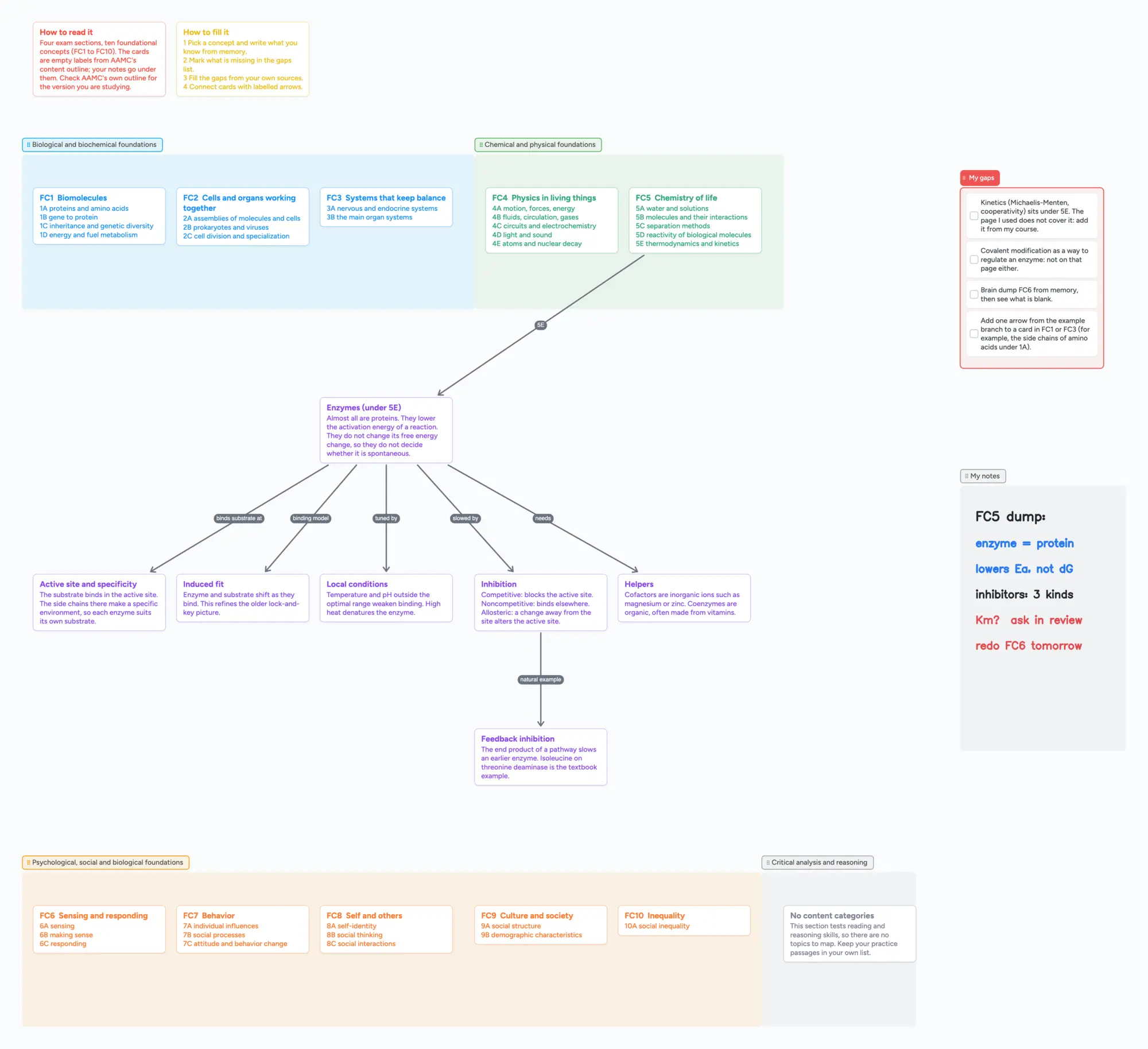
Everything on the board is an editable card, list or section, and nothing on it is a photo.
- Two cards at the top say how to read the board and how to fill it.
- Three coloured sections hold the ten foundational concept cards (FC1 to FC10). Each card carries its AAMC category labels in a line each, for example "5E thermodynamics and kinetics". The blank space under each card is where your notes go.
- A grey section for critical analysis and reasoning with one card saying there are no topics to map. Keep your practice passages in your own list.
- A purple enzyme branch hangs under FC5 on a captioned arrow (5E): enzymes, then active site and specificity, induced fit, local conditions, inhibition and helpers, each on a labelled arrow, and feedback inhibition under inhibition.
- A red gaps list, with four checkbox cards. A grey section for pen notes, with an example brain dump in ink.
Arrows stay attached when you move a card or a section. Pen strokes drawn inside a section move with it.
Fill it from memory first
Most MCAT map advice says not to copy your textbook onto the map. One r/Mcat post (2025-04-06, 21 points, 4 comments, read in full on November 10, 2026) lays out five steps: choose a central topic, brain dump what you know from memory, spot your gaps, learn the gaps, then expand and connect. The poster says the point is to structure your knowledge gaps, not to make a pretty diagram, and that it works alongside Anki. This is one student's view. The comments add no disagreement and no evidence.
- Pick one foundational concept and write what you can recall under its card, in your own words. Use the pen section if writing by hand is faster for you.
- Open the gaps list and add one card for each thing you could not recall or were unsure of. Tick it off when you have learned it.
- Fill each gap from your own sources: your course notes, your prep books, the AAMC outline itself. The board holds no content to fill it for you.
- Draw an arrow between cards that depend on each other and caption it with the relationship. The example branch does this for enzymes.
- Repeat per concept. The example gaps list already points to one cross-link to add: the side chains of amino acids under 1A link to the active-site card.
To go deeper on a topic, Boardling has short lessons: for the plasma membrane under 2A, the sodium-potassium pump lesson and notes cover what the pump moves, 3 sodium out and 2 potassium in for 1 ATP; for the nervous system under 3A, the action potential lesson and notes follow one action potential from rest to the peak and back; for the circulatory system under 3B, the Frank-Starling lesson and notes show why more filling makes the next beat stronger; for oxygen transport by blood, also under 3B, the oxygen-hemoglobin curve lesson and notes show how hemoglobin holds oxygen in the lungs and lets it go in a working muscle; and for the excretory system under 3B, the nephron lesson and notes walk through filtration, reabsorption and secretion along one nephron, and the RAAS lesson and notes follow renin, angiotensin II and aldosterone through the kidney, liver, lungs and adrenal glands.
The worked branch: enzymes under 5E
The branch is there to show the size and shape of a filled-in branch, not to teach enzymes. Its cards paraphrase OpenStax Biology 2e, section 6.5 (read in full on November 10, 2026): enzymes are almost all proteins and lower the activation energy; the substrate binds the active site; induced fit refines the lock-and-key picture; temperature and pH outside the optimal range weaken binding, and high heat denatures the enzyme; competitive inhibition blocks the active site while noncompetitive inhibition binds elsewhere, and allosteric inhibition changes the enzyme's shape; cofactors are inorganic ions such as magnesium and zinc, and coenzymes are organic and often come from vitamins; and the end product of a pathway can inhibit an earlier enzyme, as isoleucine does to threonine deaminase.
That page does not cover kinetics (Michaelis-Menten, cooperativity) or covalent modification as a way to regulate an enzyme, so those two sit on the gaps list. Check what your own course expects against AAMC's outline, not against this board.
Lessons for single branches
Boardling is the Instaboard team's biology channel. Each short lesson below covers a topic that would sit under one card on this map. The line above each video says which foundational concept and category the outline files it under, using the outline's own topic names (the outline we cite is dated 2020). The outline lists topics, not lessons, so a lesson covers part of a topic, and your own course materials decide what you need.
Watch the sodium-potassium pump lesson
Under foundational concept 2, category 2A (plasma membrane): the outline lists active transport with the sodium/potassium pump, and membrane potential. This lesson covers what the pump moves, 3 sodium out and 2 potassium in for 1 ATP, and its part in the resting potential.
Sodium Potassium Pump MCAT: 3 Sodium Out, 2 Potassium In
2:07 min · Notes and board
Watch the action potential lesson
Under foundational concept 3, category 3A (nervous system): the outline lists resting potential, action potential, threshold and all-or-none. This lesson follows one action potential across the graph, from rest at about -70 mV to the peak and back.
Action Potential MCAT: Every Step on the Graph
2:21 min · Notes and board
Watch the Frank-Starling lesson
Under foundational concept 3, category 3B (circulatory system): the outline lists the four-chambered heart, structure and function, and doesn't name this law. This lesson shows why more filling makes the next beat stronger: preload, sarcomere stretch and stroke volume.
Frank-Starling Law Explained: More Filling, Stronger Beat
2:19 min · Notes and board
Watch the oxygen-hemoglobin curve lesson
Under foundational concept 3, category 3B (circulatory system): the outline lists oxygen transport by blood, with hemoglobin, oxygen content and oxygen affinity. This lesson reads the S-shaped curve, then the Bohr effect and a right shift.
Oxygen Hemoglobin Dissociation Curve MCAT: Step by Step
2:33 min · Notes and board
Watch the nephron lesson
Under foundational concept 3, category 3B (excretory system): the outline lists nephron structure and the formation of urine, with glomerular filtration, secretion and reabsorption. This lesson walks through the three jobs and where ADH acts at the collecting duct.
Nephron MCAT: Filtration, Reabsorption, Secretion
2:25 min · Notes and board
Watch the RAAS lesson
Under foundational concept 3, category 3B (excretory system): the outline lists blood pressure and osmoregulation among the kidney's roles, and doesn't name renin or aldosterone. This lesson follows the chain through kidney, liver, lungs and adrenal glands.
RAAS MCAT: Renin, Angiotensin, Aldosterone Step by Step
2:20 min · Notes and board
Watch the digestive enzymes lesson
Under foundational concept 3, category 3B (digestive system): the outline lists the pancreas producing enzymes and sending them to the small intestine, and the small intestine as a site of digestion. This lesson covers starch, protein and fat, and how the pancreas keeps its protein-cutting enzymes inactive until they arrive. The enzyme branch above sits under 5E.
Digestive Enzymes MCAT: Starch, Protein, Fat Step by Step
2:40 min · Notes and board
When something else is the better choice
These lines come from each source's own page, read on November 10, 2026.
- You want to know what is tested. AAMC's "What's on the MCAT Exam?" outline PDF is the source of the ten foundational concepts and their categories. The copy we read is dated 2020 (footer "© 2020 Association of American Medical Colleges"), so check AAMC's own page for the version your test date uses. The board uses the category names as short labels and doesn't reproduce the outline.
- You want spaced repetition. Anki's own site describes it as a flashcard program that spends more time on challenging material, where you rate your recall and Anki schedules the next review. Instaboard has no flashcard, quiz or scheduling mode.
- You want study material for the content. Prep companies such as Jack Westin have their own MCAT content pages (its MCAT Content page was mostly a sign-up page when we read it, so we don't describe what is behind it). We publish none.
- You want a mind-map app with its own layout tools. A dedicated mind-map or note app may lay out and collapse branches for you. Here you place the cards yourself. MindMeister alternatives covers what one such app's free plan keeps.
What this board doesn't do
- It holds no MCAT content, apart from the one enzyme branch. It is not a content review.
- It doesn't track what you have learned, beyond the checkboxes on the gaps list.
- No spaced repetition, quizzes or scores.
- The free plan: 5 boards and 150 items per account (cards, lists, images, text boxes count; pen strokes, sections and arrows don't), 3 images and 1 file per board. The ready board leaves about 125 items free, so filling in ten concepts fits on one free account, but a second course's worth of boards may not. Pro ($5 a month billed yearly, $59.99, or $7.99 monthly) has no image limit.
- Writing needs a free sign-in. Anyone with the link can view; set Share to "Anyone who joins can edit" if you want a study partner to write on it.
- Written for adult learners. Instaboard's terms say users are not minors.
Start from the ready board
It opens in your browser in a few seconds, with nothing to install. Sign in for free when you want to save it and share it.
Questions
Is there a template for an MCAT concept map?
This board is one: ten empty foundational concept cards under AAMC's four sections, one worked enzyme branch, a gaps list and a pen notes section. Making your own copy takes 1 of your 5 free boards.
Does the board contain MCAT content?
No, apart from one worked enzyme branch paraphrased from OpenStax Biology 2e, section 6.5. The other cards are empty labels from AAMC's content outline. The board is a map for your own notes, not a review.
Is this the current AAMC outline?
The AAMC outline PDF this board follows is dated 2020 ("© 2020 Association of American Medical Colleges"). The board does not say which MCAT version it matches, so check AAMC's own page for your test date.
Can I use it with Anki?
Yes, side by side. Anki schedules your reviews. The board is where you lay out how concepts connect and what you still can't explain. Instaboard has no flashcard or spaced-repetition mode.
Can a study partner edit it with me?
Yes. Set Share to "Anyone who joins can edit"; new boards start view-only. Your partner signs in free to write. The board counts as 1 of their 5 free boards, and cards they add count toward their own 150 items.
Is Instaboard free?
Yes. The free plan includes 5 boards, 150 cards and items across your account (pen strokes, arrows and sections don't count), 3 images and 1 file per board, unlimited collaborators and video calls up to an hour. Pro is $5 a month billed yearly ($59.99 a year), or $7.99 monthly, and the people you invite join free.
Sources
- AAMC: What's on the MCAT Exam? content outline PDF (111 pages, "© 2020 Association of American Medical Colleges"; foundational concept framework read Nov 10, 2026)
- OpenStax Biology 2e, 6.5 Enzymes (read in full, Nov 10, 2026)
- Reddit r/Mcat: Mindmapping is the secret to make things click (2025-04-06, 4 comments, read in full, Nov 10, 2026)
- Anki: powerful, intelligent flashcards (read in full, Nov 10, 2026)
- Jack Westin: MCAT Content (page read Nov 10, 2026; mostly sign-up text)
Related
Build an immune system concept map: innate vs adaptive, step by step
Build an immune system concept map: innate and adaptive clusters, then one infection traced to memory. An editable board, sourced from OpenStax. No AI.
Make a biology concept map from your own notes
Turn your lecture notes into a biology concept map: concepts on cards, labelled arrows, feedback loops and a recall check. Worked example on the HPA axis, a ready board to copy, and a nursing version.
How to take anatomy & physiology notes (with a filled example board)
How to take anatomy and physiology notes on a board you can edit: draw the feedback loop first, then terms, examples and a self-quiz. A filled homeostasis example built from OpenStax A&P 2e, for college and nursing students.
How to organize photos of handwritten notes on one study board
Lay out photos of your handwritten notes beside your own-words cards on one board. The free plan holds 3 photos per board and 5 boards: at most 15 photos.