For novelists outlining chapter by chapter
24-chapter novel outline board: acts, chapters and beats on one shared board
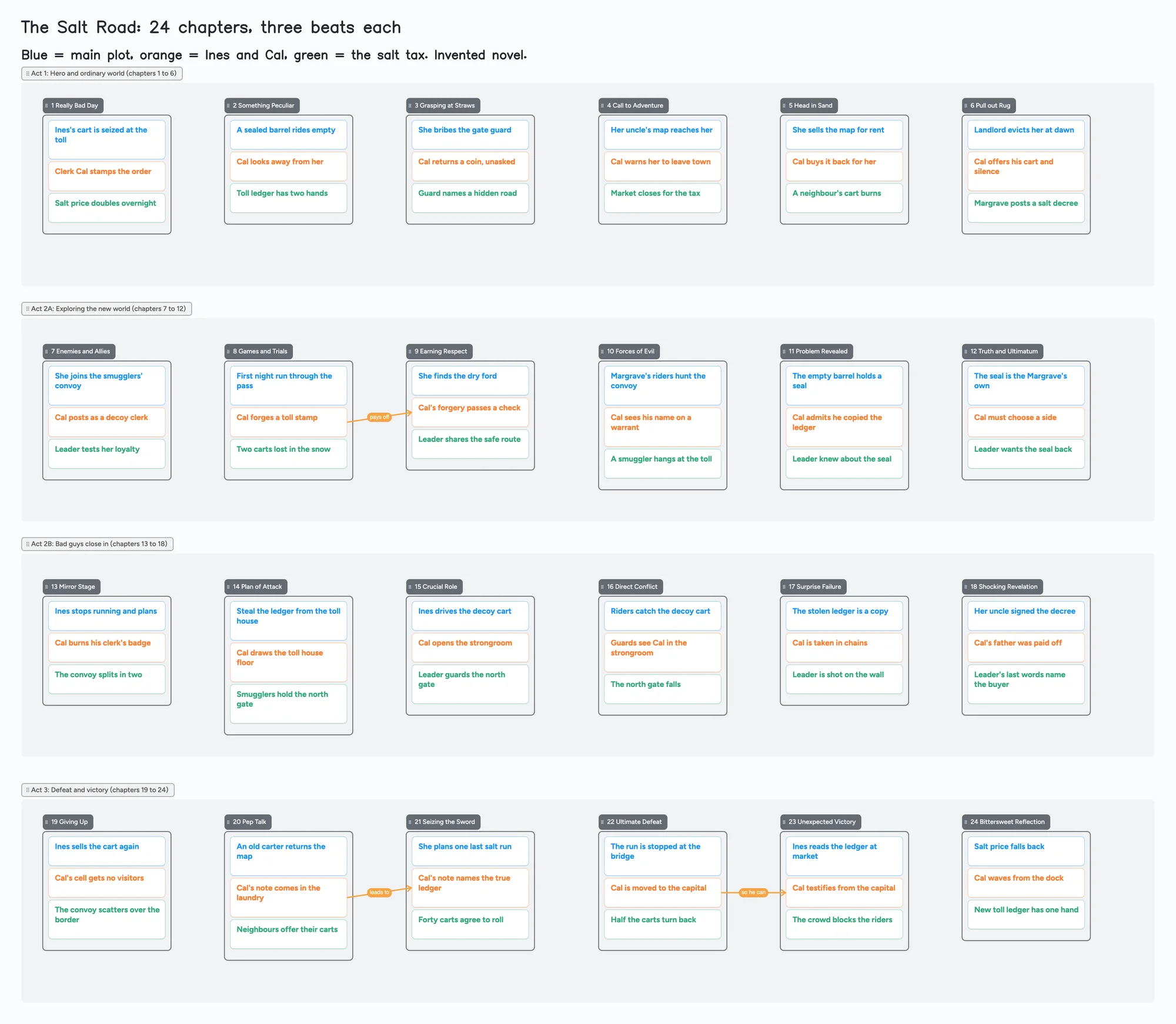
We make Instaboard, a free online board. This page gives you a 24-chapter novel outline already laid out on it: four act sections, one list per chapter, and three beat cards in each list, one for the main plot, one for the relationship and one for the subplot. The story is invented and the chapter names follow Derek Murphy's 24-chapter outline. Open it, replace the story with yours, and send one link to a co-writer, a coach or an editor. Before you build: every card and every list counts toward the free plan's 150 items, and a 36-chapter book in this shape is 144 of them.
Opens in your browser. Anyone can view; a free sign-in lets you edit.
Updated
The short answer
- Acts are sections, chapters are lists, beats are cards. Section frames group the chapters without costing anything, each chapter is a list you can drag, and each beat is a card with its own colour. Move a card to another list when a beat belongs to a different chapter.
- Count the items before you copy it. Each list, card and text box is one item; sections, arrows and pen strokes aren't. 24 chapters with 3 beats each is 24 lists plus 72 cards, 96 items; the title text box on the ready board makes it 97. 27 chapters is 108, and 36 chapters is 36 lists plus 108 cards, 144 of the free 150 (our arithmetic). A character list or a setting note on the same account takes some of what is left.
- Leaner shape: one card per chapter with the beats as lines inside it. 36 chapters in four act lists is 40 items (our arithmetic). The index-card page has that shape.
- Pro lifts the limit: $5 a month billed yearly ($59.99), or $7.99 monthly. The free plan keeps 5 boards, 150 items and 3 pictures per board.
- Anyone with the link can read it; writing takes a free sign-in. New boards start view-only. Set "Anyone with the link can edit" if a co-writer or editor should add cards.
- What it doesn't have: a timeline axis, word counts, beat-sheet guidance, a manuscript editor, and export to Plottr or Scrivener. It holds the outline, not the book.
What this board doesn't do, before you build
- No timeline axis and no word counts. Plottr and Dabble show the story along a timeline or grid; here the order is the order of the lists and cards.
- No beat guidance. The board is filled with an example, not with prompts. Reedsy Studio's template adds guided questions to each beat (below).
- No manuscript. There is nowhere to draft the chapters. Write in your word processor, Scrivener, Dabble or Campfire.
- No export to Plottr, Scrivener or Word. You can copy a selection as a picture; cards don't turn into files.
- No hidden notes on the free plan. Everyone with the link sees every card.
- 3 pictures per board. The ready board has none.
What the 24-chapter outline is, and the 27-chapter one
The 24-chapter outline is Derek Murphy's way of laying a novel out as a three-act story in 24 numbered chapters. Plottr's page (June 24, 2024) offers it as a template with four plotlines, 34 scene cards and 25 spaces for beats, and Murphy's own page gives it away as a one-page Word, PDF or Google Docs file. Plottr's page splits it into Act 1 (chapters 1 to 6), Act 2A (7 to 12), Act 2B (13 to 18) and Act 3 (19 to 24), which is the split this board uses.
Campfire's blog has a separate 27-chapter method, "The 27-Chapter Outline and the Power of Three: Setup, Conflict, Resolution" (last updated May 13, 2024): three acts of nine chapters each. The section below says how it divides the chapters, what it costs in items on a board, and where Campfire and LivingWriter are the better choice.
The 27-chapter outline on a board: what it is and what it costs in items
Limits first. The ready board above is the 24-chapter shape, so a 27-chapter outline means adding three chapter lists and renaming the rest yourself. The board has no chapter prompts, no timeline, no word counts and no manuscript, and the free plan holds 150 items across all your boards. Nothing in this section changes the ready board.
What the method is, from three pages we read in full on November 19, 2026. Campfire's article (last updated May 13, 2024) and Bookstr's (by Lauren Nee, August 8, 2024) both credit Kat O'Keefe, who posts on YouTube as @katytastic; LivingWriter's post says she made it popular. All three describe three acts, each of nine chapters, which Campfire and Bookstr group into three blocks of three chapters per act: 3 acts x 3 blocks x 3 chapters = 27. Campfire and Bookstr say every level follows the same setup, conflict, resolution pattern. Act 1 runs from the ordinary world through an inciting incident to a push out of it, Act 2 has a midpoint and a reversal, and Act 3 runs from a darkest point through a climax to a resolution. LivingWriter says the book needn't end up with exactly 27 chapters; what matters is what each block does.
The three pages name some chapters differently: Bookstr's "Midpoint Incident" is Campfire's "Midpoint", and LivingWriter's third chapter is "Immediate Reaction" where Campfire and Bookstr say "Fallout". Use your own names rather than one vendor's list. Campfire and Bookstr both note that nine chapters per act contradicts the usual advice of about a quarter of the book, a half and a quarter, and Bookstr adds that the method leaves no room for a prologue or an interlude. Campfire quotes Kat O'Keefe saying not to let the structure hold you back; Bookstr links her YouTube videos on the method, which we did not watch.
Our layout, which is a choice and not part of the method: three act sections, 27 chapter lists, and the same three beat cards in each list as the ready board (main plot, relationship, subplot). Put the block number in each list title if you want to see the nine blocks. Sections don't count toward the 150. Our arithmetic:
| Layout | Lists | Cards | Items | Of the free 150 |
|---|---|---|---|---|
| 27 chapter lists, 3 beat cards each | 27 | 81 | 108 (109 with a title text box) | 42 left |
| 27 chapter lists, 1 card each | 27 | 27 | 54 | 96 left |
| 9 block lists, 3 chapter cards each | 9 | 27 | 36 | 114 left |
Swipe the table sideways to see every column.
Our arithmetic from the free plan's 150 items. A character list or notes on any of your boards use the same 150.
Where the other tools are better, from their own pages read November 19, 2026:
| Tool | What its page shows for the 27-chapter outline | What its page says about cost | Where it is better |
|---|---|---|---|
| Campfire | Its article lists every chapter and says a 27-Chapter Method template for its Timeline Module can be loaded (View tab, Manage Templates) and edited; double-clicking a panel opens a canvas for that card | Free plan $0, no credit card, limited access to every module, with the Timeline listed at 20 events. The page doesn't say whether template panels count against the 20, so not checked. Standard is $12 a month shown beside a struck $19 | A timeline template with a canvas inside each panel, and the manuscript in the same project |
| LivingWriter | Its blog post says the editor has a 27 Chapter Method template with the outline pre-filled (3 acts, 27 chapters), a Board view that shows the acts as blocks "designed similar to index cards", expandable into chapters, and a Status field for each chapter | Its pricing page text showed no plan figures to us, so price not checked | Outline and draft in one app, with a status on each chapter |
| Bookstr's article | A step-by-step breakdown of every chapter, a worked example on The Hunger Games, and pros and cons | Free to read | A worked example of the method; this board has no example of its own for 27 chapters |
Swipe the table sideways to see every column.
Read November 19, 2026. LivingWriter's blog post shows no date. Neither Campfire's nor LivingWriter's template was opened in the app; both are as their pages describe them.
Writers disagree about chapter-per-beat templates. The r/writing thread this page cites for the 24-chapter outline (January 2021; the page returned 25 of its 79 comments) is about Murphy's outline, not the 27-chapter one, but its objections apply to both. u/laxnut90 (score 61) thought the first six chapters of Murphy's outline should be three at most, and a commenter whose account is deleted (score 44) answered that Harry Potter doesn't reach Hogwarts until chapter seven. Each is one person's view. On a board, moving a beat to a different chapter is a drag, not a rewrite.
How many items a chapter outline uses
The free plan allows 150 items across all your boards. Each card, list and text box is one item. Section frames, arrows and pen strokes don't count. Our own arithmetic for the layout on this page (the ready board adds one title text box, so it is 97):
| Book | Layout | Lists | Cards | Items | Of the free 150 |
|---|---|---|---|---|---|
| 24 chapters, 3 beats each | A list per chapter | 24 | 72 | 96 | 54 left |
| 27 chapters, 3 beats each | A list per chapter | 27 | 81 | 108 | 42 left |
| 36 chapters, 3 beats each | A list per chapter | 36 | 108 | 144 | 6 left |
| 36 chapters, 4 beats each | A list per chapter | 36 | 144 | 180 | Over 150 |
| 36 chapters, one card each | One list per act | 4 | 36 | 40 | 110 left |
Swipe the table sideways to see every column.
Our arithmetic from the free plan's 150 items. Items are counted across all your boards, so a character list or notes on another board use the same 150.
If you reach the limit, you can move to one card per chapter, or upgrade: Pro is $5 a month billed yearly ($59.99) or $7.99 monthly and has no item limit.
How the ready board is laid out
Derek Murphy's 24-chapter outline (his own page, read November 15, 2026) numbers its sections 1 to 24 and notes that the downloads are called the 24-chapter outline although the list on the page has 25 numbered sections, with Death of Self as the 25th. Plottr's page groups the same chapters into four parts, and so does the board here:
- Act 1, chapters 1 to 6: the hero and the ordinary world, from Really Bad Day to Pull out Rug.
- Act 2A, chapters 7 to 12: exploring the new world, from Enemies and Allies to Truth and Ultimatum.
- Act 2B, chapters 13 to 18: the bad guys close in, from Mirror Stage to Shocking Revelation.
- Act 3, chapters 19 to 24: defeat and victory, from Giving Up to Bittersweet Reflection. Add a 25th list if you want the optional Death of Self chapter.
The chapter names are Murphy's. The story, the characters and every beat on the board are invented for this page, and the three beats per chapter are our choice, not part of his outline: the main plot (blue), the relationship between the two leads (orange) and a subplot, here a salt tax (green). Use different colours for your own plotlines. Three arrows show a planted detail and where it pays off; they stay attached when a card is moved or a list is reordered.
How to set it up for your own novel
- Open the ready board and sign in free to edit it. Rename the chapter lists if your structure isn't Murphy's.
- Fill the main-plot cards first, one line each, top to bottom through the 24 chapters. If a chapter has no main-plot beat, that is the gap to fix.
- Add the relationship and subplot cards and give each plotline its own colour.
- Draw an arrow when a detail is planted and when it pays off. Give it a caption so you can read it later.
- Move cards rather than rewriting them. A beat that arrives too early goes into the next list; a chapter you cut leaves its list empty, so delete the list to free the item.
- Share the link. Anyone with it can read; writing needs a free sign-in, and a signed-in co-writer or editor writes live. Give each person their own cards, because two people typing in the same card at once are merged keystroke by keystroke with no lock.
A board someone opens from your link counts as one of their own 5 free boards; the cards they add count toward their own 150 items, not yours.
3-act structure in plain terms
A three-act outline splits the book into a beginning (the setup), a middle (the conflict) and an end (the resolution). The 24-chapter outline cuts the middle in two, which is why this board has four act sections. If you want plain thirds, use three sections: 8 chapters each for a 24-chapter book, or 9 each for a 27-chapter book (our arithmetic). A bare nine-beat three-act outline, three beats a section, is 9 cards in three lists, 12 items.
Reedsy Studio's free three-act template (read November 15, 2026) is that nine-beat shape with guided questions on each beat; use it if you want prompts, because this board has none. To plot by beats rather than chapters, see the 15-beat novel beat sheet board.
Who the 24-chapter outline is for, and who it isn't
Plottr's page says the outline serves writers who want to produce commercial fiction and like step-by-step guides. StorytellingDB (May 20, 2025) says it was designed for commercial genres and works best for 50,000 to 75,000 words, roughly 2,000 to 3,000 words a chapter, and that longer epics need extra scenes for other points of view and subplots. If your book is literary, very long or heavily multi-POV, use the board for the spine and add lists for the rest, and keep the item count in mind.
Writers disagree about templates like this. In r/writing in January 2021, u/monsterfurby (score 346) said a template is a good tool but not a cure-all, and that the most value came from outlining or drafting first and then using it to reshuffle scenes and chapters; u/laxnut90 disagreed with making each stage its own chapter and thought the first six should fit in three chapters at most. In r/writing in 2019, u/Curliness described a plain list of chapter numbers with one line on what happens in each. Each is one person's view.
A board suits the reshuffling part well: a beat is a card you drag, not a paragraph you cut and paste.
When something else is the better choice
Each line is from the maker's own page, read on November 15, 2026. Plans change, so check the page before you pay.
| Tool | What it does well for a chapter outline | What its page says about cost | Where this board is different |
|---|---|---|---|
| Instaboard | A chapter outline as lists and cards you drag, with colour per plotline and arrows between beats; shared by one link | Free: 5 boards, 150 items, 3 pictures per board. Pro $5 a month billed yearly, or $7.99 monthly | No timeline, no guidance, no manuscript, no export. Writing takes a free sign-in |
| Plottr | A 24 Chapter Novel Outline template with four plotlines, 34 scene cards and 25 spaces for beats, plus a timeline view and series tools (its 24-chapter page) | Needs a Plottr plan or a free 30-day trial. The pricing page lists Plottr at $60 a year for Windows and Mac and Plottr Pro at $99 a year or $9.99 a month, with a browser app, cloud sync and real-time collaboration on Pro | Plottr is better for a timeline, templates and a series. Real-time collaboration is on Pro |
| Reedsy Studio | A Three-Act Structure template: 9 beats across an Outline board plus Characters and Places boards, 19 cards, guided questions and a worked Pride and Prejudice example; a manuscript editor and export in the same app | Its template page calls Studio a free app | Reedsy Studio is better for guided beats and for drafting in the same place. It is a three-act, nine-beat template, not 24 chapters |
| Dabble | A Plot Grid and a three-act worksheet (a PDF to download); drafting, co-authoring and goals | Writer $15 a month billed annually ($180 a year), with a 14-day trial and no card (pricing page); no free plan listed | Dabble is better if you want to plot and write in one app. A subscription |
| Campfire | Arcs, characters, timeline and a manuscript module; a 27-chapter plotting article on its blog | A free plan with limited modules, including Manuscript 25,000 words and Arcs 3; Standard is $12 a month, shown beside a struck $19 (pricing page) | Campfire is better for a story bible and a draft. Its free plan caps arcs and words |
| Murphy's free template | The 24-chapter outline as a one-page Word, PDF or Google Docs file with an expanded Word version for notes, and a video walkthrough (his page) | Free download | The template is better if you work alone and want it on paper. It isn't shared or movable |
| Bransford's spreadsheet | A 50-chapter Google Sheet: a column per character, a row per chapter, colour-coded plot framework (his 2019 post) | Free to copy or download as Excel; he asks people not to request edit access | A sheet is better for character columns and sums. Its cells can't be dragged around like cards |
Swipe the table sideways to see every column.
Read November 15, 2026. Bransford's post is from June 2019. Campfire's 27-chapter article, Bookstr's and LivingWriter's were read in full on November 19, 2026 (see the 27-chapter section). The Reedsy page doesn't say how Studio is paid for beyond calling it free.
- You want the outline and the manuscript in one place. Reedsy Studio, Dabble, Campfire and Scrivener keep both; this board holds only the outline.
- You want a timeline. Plottr's template runs along a timeline. This board has none. For what Plottr costs and how it compares, see Plottr and its free alternatives.
- You want one printed page. Murphy's one-page download is made for that.
- You are outlining a screenplay or TV pilot. See the index-card outline page, which uses four act lists and a card per scene.
Limits, in one list
- 150 items, 5 boards and 3 pictures per board on the free plan; Pro removes the limit.
- No timeline axis, no word counts, no beat prompts, no manuscript.
- No export to Plottr, Scrivener or Word, and no import from them.
- No hidden lists on the free plan: everyone with the link sees everything.
- Writing needs a free sign-in; reading doesn't.
Once the first draft exists and you have reader notes, the novel revision board turns them into a plan. For a partner plotting with you, see the Plottr alternatives page.
Start from the ready board
It opens in your browser in a few seconds, with nothing to install. Sign in for free when you want to save it and share it.
Questions
Is there a free 24 chapter novel outline template online?
Derek Murphy's own page offers the outline free as a Word, PDF or Google Docs file. The board on this page is a filled version you can open, move around and share by link; it is free to open, and editing takes a free sign-in. The free plan has 150 items, and the ready board is 97 of them (24 lists, 72 cards and a title text box).
How many items does a chapter-by-chapter outline use?
Each list, card and text box counts as one item. 24 chapters with three beats each, one list per chapter, is 96 items, and the ready board adds a title text box for 97; 36 chapters is 144. One card per chapter in four act lists is 40 items for 36 chapters (our arithmetic). Sections, arrows and pen strokes don't count.
Can I use it for a 3 act structure novel outline?
Yes. Make three sections and one list per chapter or per beat. The ready board uses four act sections because Murphy's outline splits the middle in two. A nine-beat three-act outline is 9 cards in three lists, 12 items.
What goes in a chapter outline for a novel?
What changes in the chapter, in a line or two, plus which plotline it moves. The ready board has three cards per chapter: the main plot, the relationship and a subplot. Some writers keep only one line per chapter, which is the leaner shape above.
Can a co-writer or editor work on it with me?
Yes. Set "Anyone with the link can edit" and send the link. They sign in free to write, and what they move shows up for you within a few seconds. Give each person their own cards: two people typing in the same card at once are merged keystroke by keystroke with no lock.
Can I export the outline to Plottr or Scrivener?
No. There is no export to Plottr, Scrivener or Word. You can copy a selection as a picture. If you need the outline in those apps, build it there.
What if I go past 150 items?
On the free plan you can't add more items. Move to one card per chapter, delete cards you no longer need, or upgrade: Pro is $5 a month billed yearly ($59.99) or $7.99 monthly and has no item limit.
What is a 27 chapter outline?
A way to outline a novel in three acts of nine chapters each, grouped into three blocks of three chapters (3 x 3 x 3 = 27). Campfire and Bookstr credit Kat O'Keefe, who posts on YouTube as @katytastic, and say every level follows a setup, conflict, resolution pattern. On a board it is three act sections and 27 chapter lists; with three beat cards in each, that is 27 lists plus 81 cards, 108 items of the free 150 (our arithmetic). Instaboard has no chapter prompts, timeline or manuscript; Campfire and LivingWriter describe a 27-chapter template in their own apps.
How do I outline a fantasy novel chapter by chapter?
Our suggestion: use the chapter board for the spine of the story, and make the third beat card in each chapter the thing your world adds, such as a kingdom, an artifact or the cost of magic. Plottr's fantasy page suggests tracking lore, magic systems, artifacts and kingdoms as plotlines (read November 19, 2026). The board holds the plot, not the world: every map, culture or magic-rules card counts toward the free 150 items, so keep a world bible in a tool built for one. Reedsy's Fantasy Starter Kit pairs a 12-stage Hero's Journey outline with worldbuilding, character and place boards, and its page says the full kit library is an Outlining add-on with a 30-day trial. Novel Factory's list of eight outlines has no fantasy one.
How do I outline a thriller chapter by chapter?
Put the first jolt in chapter 1. Reedsy's thriller guide says to start with action, though not necessarily a murder, while the 27-chapter outline spends its first chapters on an ordinary world and the inciting incident in chapter 2. On the board you can drag the inciting card into the first chapter's list; that reordering is our suggestion, not Reedsy's or Campfire's. Campfire and Bookstr's 27-chapter outline has a plot-twist chapter in Act 1 (chapter 8) and another in Act 3 (chapter 20), which fits Reedsy's advice to keep twists coming. Our suggestion: use the third beat card in each chapter for the antagonist's move, so you can see whether the pressure rises. Plottr sells a pack of eight thriller templates with 25 to 45 scene cards each; Instaboard has no thriller template, escalation tracking or timeline.
How do I outline a horror novel chapter by chapter?
Plottr's horror beat sheet page (no date shown, read November 19, 2026) sets out fifteen beats in three phases, a setup, a turn and a final act, from a first hint of the monster to a closing hint that it isn't entirely beaten. That is a beat count, not a chapter count, and no page we read says which chapters should carry which horror beat, so we don't assign them. Fifteen lists is the shape of our 15-beat novel beat sheet board; on this chapter board, drop each beat into whichever chapter list it lands in and see which chapters have none. Plottr's template needs a Plottr plan or its free trial; Instaboard has no horror prompts, and the beat names on our boards are our own words.
How do I outline a romantasy novel chapter by chapter?
Decide which plot is the main one, then give each plot its own colour in every chapter. In r/fantasywriters (September 2024), u/rcg90 separated fantasy romance, where the romance is the main plot, from romantic fantasy, where the fantasy is the main plot and the romance a subplot, and u/Masochisticism said to decide which you are writing. u/Canuck_Wolf and u/Logisticks added that romance readers expect a happily-ever-after or happy-for-now ending. Each is one person's view. On the chapter board the main plot and the relationship are already two of the three beat cards, so swap which one leads and use the third for the antagonist or the magic; a chapter with an empty relationship card shows where the romance drops out. No page we read says which chapters should carry which romance beat, so we don't. Novel Factory offers a romance outline as a free PDF.
Is Instaboard free?
Yes. The free plan includes 5 boards, 150 cards and items across your account (pen strokes, arrows and sections don't count), 3 images and 1 file per board, unlimited collaborators and video calls up to an hour. Pro is $5 a month billed yearly ($59.99 a year), or $7.99 monthly, and the people you invite join free.
Sources
- Plottr: 24 Chapter Novel Outline (Jun 24, 2024; read Nov 15, 2026)
- Plottr: pricing (read Nov 15, 2026)
- Creativindie (Derek Murphy): free 24-chapter novel outline template (read Nov 15, 2026)
- StorytellingDB: 24 Chapter Novel Outline (May 20, 2025; read Nov 15, 2026)
- Reedsy Studio: Three-Act Structure template (read Nov 15, 2026)
- Dabble: pricing (read Nov 15, 2026)
- Dabble: three-act structure worksheet (Jan 6, 2026; read Nov 15, 2026)
- Campfire: pricing (read Nov 15 and Nov 19, 2026)
- Campfire: The 27-Chapter Outline and the Power of Three (last updated May 13, 2024; read in full Nov 19, 2026)
- Bookstr: How to Write Your Novel Using the 27-Chapter Method (Lauren Nee, Aug 8, 2024; read in full Nov 19, 2026)
- LivingWriter: 27 Chapter Method Made Easy (page shows no date; read in full Nov 19, 2026)
- Nathan Bransford: How to outline a novel (Jun 2019; read Nov 15, 2026)
- r/writing: "I just found the most complete 24-Chapter/3-Act-Structure…" (Jan 2021, read Nov 15 and Nov 19, 2026; 25 of 79 comments returned)
- r/writing: "When outlining a novel how do you organize your outline?" (Jan 2019, read in full Nov 15, 2026)
- Novel Factory: 8 Novel Outline Templates For 2026 (By Genre) (page shows no date; read in full Nov 19, 2026)
- Plottr: Fantasy Novel Outline Templates (page shows no date; read in full Nov 19, 2026)
- Plottr: Thriller Roadmap Pack (page shows no date; read in full Nov 19, 2026)
- Reedsy Studio: Fantasy Starter Kit (page shows no date; read in full Nov 19, 2026)
- Reedsy: How to Write a Thriller in 7 Heart-Stopping Steps (page shows no date; read in full Nov 19, 2026)
- r/fantasywriters: "What would be your guide to writing romantasy.....or executing it well?" (Sep 10, 2024; 25 comments returned, read Nov 19, 2026)
Related
Outline a novel or screenplay with index cards, on a board you can share
Outline a novel or screenplay on digital index cards: one list per act, 40 short cards, subplot arrows, a co-writer on the same board. Free to start; TV pilot too.
A novel revision board: your reader and editor notes, sorted into a plan
A shared novel revision board: reverse outline, beta reader notes sorted into must fix and consider, an editor's letter, and three passes. Free to open.
A mystery novel outline board for suspects, clues and red herrings
Outline a mystery novel on one board: a list per suspect, clues, red herrings and reveal order. A free ready board, and where Plottr and Sheets do more.
A free Plottr alternative for plotting with a partner, and where Plottr is better
Plottr's live collaboration needs Pro for each person. A free shared plotting board for two writers, and where Plottr, Scyn and Kindling do better.
A novel beat sheet on one shared board: 15 beats, three acts, scenes under each beat
A 15-beat novel outline to open and edit: 3 act sections, a list per beat, scene cards under each. Free-plan item counts and where other tools are better.